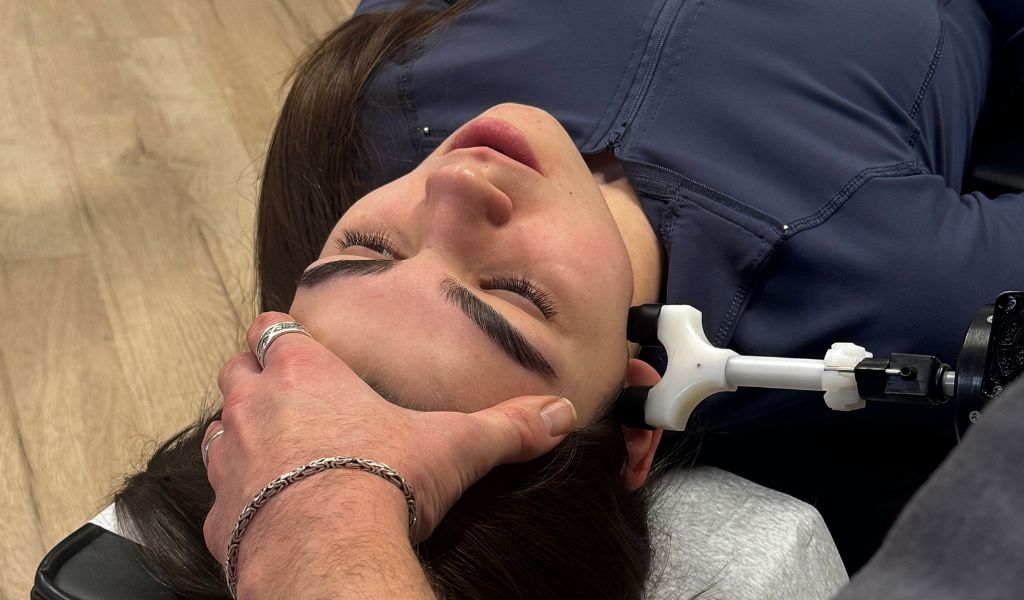
Somebody comes in for neck pain, and halfway through the intake they mention, almost as an afterthought, “oh, and my jaw clicks sometimes, but that’s probably unrelated.” It’s rarely unrelated. The jaw and the neck share muscles, share nerve pathways, and share postural habits, and treating one without looking at the other is a common reason TMJ symptoms don’t fully resolve.
Why the Jaw and Neck Are Connected in the First Place
Your temporomandibular joint — the hinge in front of your ear where your jaw connects to your skull — doesn’t operate in isolation. Several of the muscles involved in jaw movement, like the muscles at the base of your skull and the upper neck, also play a role in head posture. When your head sits forward of your shoulders — the posture almost everyone develops from hours at a screen — the muscles that stabilize your jaw and upper neck have to work overtime just to hold your head up. That constant extra load changes how your jaw sits and moves, and over time it can contribute to clicking, popping, grinding, or an achy jaw that seems to have nothing to do with your posture.
There’s also a shared nerve supply between the upper cervical spine and structures around the jaw and face, which is part of why jaw problems and headaches so often show up together — we cover the same referred-pain mechanism in our post on headaches behind the eyes — and why treating headaches-migraines sometimes requires looking at the jaw too.
What I’m Actually Checking
When someone comes in with jaw symptoms, the exam covers more ground than the jaw alone:
- Jaw range of motion and joint sounds. How far it opens, whether it deviates to one side, and where in the motion a click or pop happens.
- Upper cervical spine mobility. Restriction in the top two or three neck vertebrae is extremely common alongside TMJ symptoms and is often part of what’s driving them.
- Forward head posture. Where your ears sit relative to your shoulders tells me a lot about the mechanical load your jaw and neck are under all day.
- Muscle tenderness. Palpating the masseter, temporalis, and suboccipital muscles for trigger points that refer pain into the jaw, temple, or ear.
- Habits. Clenching, grinding at night, chewing gum constantly, resting your chin in your hand at a desk — these matter as much as the exam findings.
How Treatment Actually Works
This isn’t a jaw-only fix in most cases. A combined approach tends to get better, more lasting results:
Cervical Adjustments
Restoring normal motion to the upper neck reduces the compensatory strain that’s often part of the jaw’s mechanical problem. This is standard chiropractic adjustment work, just applied with the jaw connection specifically in mind.
Soft Tissue Work
Direct work on the masseter, temporalis, and suboccipital muscles reduces tension and trigger point referral that can mimic or worsen jaw pain.
Postural Correction
If forward head posture is part of the picture — and for most desk workers, it is — we build a plan to address it directly, including exercises and workstation adjustments, not just verbal advice to “sit up straighter.” Our posture reset guide walks through the same forward head posture pattern in more detail.
Coordination With Your Dentist
TMJ has a genuine dental component in a lot of cases — bite alignment, a night guard for grinding, or joint-specific dental treatment. We’re not going to try to solve a bite problem chiropractically. When the exam points toward a dental driver, we say so and coordinate with your dentist rather than working in a lane that isn’t ours.
When It’s More Than Muscle Tension
Most jaw clicking on its own, without pain, doesn’t need urgent treatment — a lot of people have some degree of joint clicking with no real dysfunction. But get it evaluated sooner rather than later if you notice:
- Your jaw locking open or closed
- Pain that’s severe or getting worse week over week
- Clicking that’s new and accompanied by significant swelling
- Jaw pain following a direct injury to the face or jaw
Locking, in particular, is worth addressing quickly — waiting on it tends to make the mechanics harder to restore.
A Note for Desk Workers
If you’re doing long stretches at a monitor for Boeing, Amazon, or anywhere else, and you notice yourself clenching your jaw during focused work or stressful calls, that clenching plus forward head posture is a very common combination behind TMJ symptoms I see in this area. It’s worth paying attention to during your workday, not just during flare-ups.
Frequently Asked Questions
Can chiropractic care fix TMJ on its own?
For a lot of people whose jaw symptoms are driven mainly by neck dysfunction and postural strain, addressing those factors makes a real, measurable difference. For people whose TMJ has a significant bite or dental-structural component, chiropractic care is one part of a broader plan that should include your dentist. The exam is what tells us which situation you’re in.
Why does my jaw click louder when I’m stressed?
Stress increases clenching and muscle tension throughout the jaw, face, and neck, which can make an existing joint issue more noticeable or more audible. It’s not that stress creates a structural problem from nothing — it tends to amplify a mechanical issue that’s already there.
Is a night guard a permanent fix?
A night guard protects your teeth from grinding damage and can reduce some muscle tension, but it doesn’t address the underlying postural or joint mechanics that may be contributing to the grinding in the first place. It’s often a useful piece of a broader plan rather than a complete solution on its own.
Ready to Get the Full Picture
If your jaw clicking, popping, or aching keeps coming back no matter what you try on your own, it’s worth having your neck and posture evaluated alongside your jaw. Our New Patient Special is $59 and covers a complete evaluation. Call (425) 276-8044 or book your appointment online — you can also read more on our dedicated TMJ services page.
References
- American Association of Oral and Maxillofacial Surgeons — TMJ Disorders
- National Institute of Dental and Craniofacial Research — TMJ Disorders
Get Started Today
Start with a complimentary consultation to ask questions and confirm fit.