Every August I see the same thing walk through the door: a kid slouched to one side, backpack slung off a single shoulder, complaining their neck or shoulder hurts by the time they get home from Renton or Lakeridge Elementary. Backpacks aren’t inherently bad for kids, but the way most of them are packed and worn absolutely is.
Why Backpack Weight Matters More for Kids
A child’s spine is still developing, and their muscles haven’t built the endurance an adult’s have. When a backpack is too heavy or worn incorrectly, kids compensate by leaning forward, arching their lower back, or shifting weight to one hip, and those compensations, repeated five days a week for a school year, add up.
The general guidance from pediatric and orthopedic sources is that a loaded backpack should stay under roughly 10-15% of a child’s body weight. That’s not an exact rule for every kid, but it’s a useful ceiling. For a 60-pound second grader, that’s around 6-9 pounds, well under what a laptop, three textbooks, and a lunch can weigh combined.
How to Actually Check the Fit
Most backpack problems aren’t really about the backpack, they’re about how it’s loaded and worn. Here’s what I walk parents through:
Weight and Packing
- Weigh the loaded backpack on a bathroom scale before school starts, don’t guess
- Put the heaviest items closest to the child’s back, not at the bottom
- Use a locker or cubby if allowed, so books don’t need to travel both ways every day
- Ask about a second set of textbooks at home if the school allows it
Strap and Fit
- Both straps, every time. One-shoulder carrying is the single biggest cause of the shoulder and neck strain I see in school-age kids.
- Straps should be snug enough that the pack sits against the back, not hanging low near the hips
- The top of the pack should sit roughly at shoulder level, not up near the neck or down at the tailbone
- A hip or chest strap, if the pack has one, transfers weight off the shoulders and onto the pelvis, which handles load far better
Signs the Backpack Is Actually Causing Problems
Watch for these at pickup or after school:
- Red marks or indentations from straps digging in
- Leaning noticeably forward or to one side while wearing it
- Complaints of numbness or tingling down an arm
- Struggling to put it on or take it off without help
If any of these show up regularly, it’s worth having the fit reassessed, and if pain persists after adjusting the pack, worth having your child evaluated. It’s the same forward-lean, text-neck-style posture pattern we cover in our posture reset guide, just from a backpack instead of a phone.
What I Check on a Pediatric Posture Exam
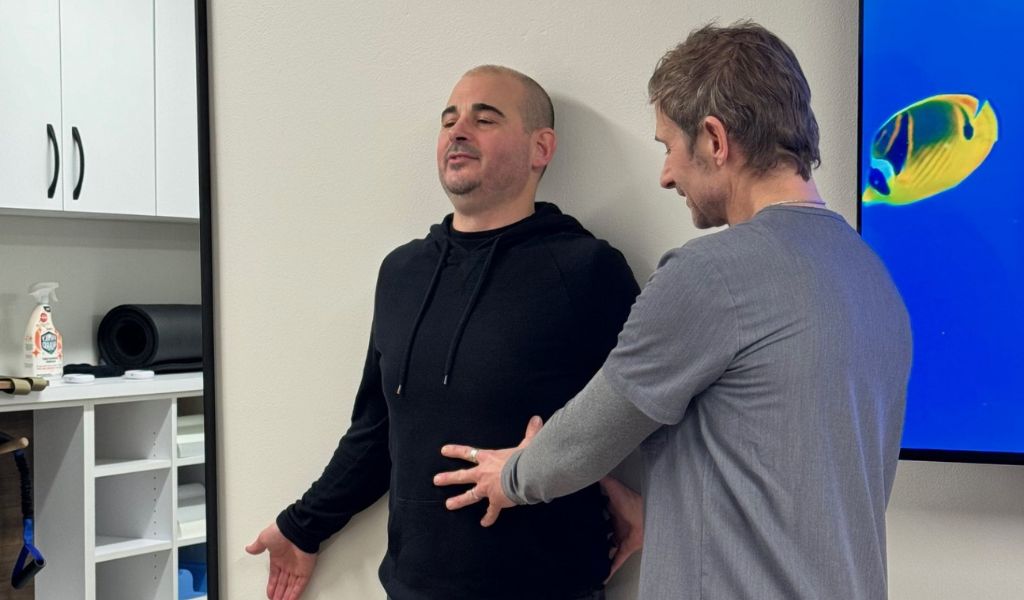
When a parent brings a child in with backpack-related complaints, I’m looking at spinal alignment, shoulder height symmetry, and how the child carries themselves standing and walking, not just where it hurts today. Repetitive one-sided loading, over months, can contribute to postural patterns that are worth catching early rather than after they’ve become a habit. This overlaps with a lot of what I look for in scoliosis screening in teens, since asymmetric loading and curvature concerns often get flagged around the same age.
When to See a Doctor Instead
Backpack strain is almost always a mechanical, fixable issue. But see a pediatrician if your child has:
- Numbness or weakness in an arm that doesn’t resolve
- Pain that persists even with an empty backpack
- Any visible curve or asymmetry in the spine when they bend forward
Frequently Asked Questions
How heavy is too heavy for a backpack?
As a general guideline, keep loaded weight under roughly 10-15% of your child’s body weight. If you have to hoist it onto their back or they lean forward to counterbalance it while standing still, it’s too heavy.
Are rolling backpacks a better option?
They can reduce shoulder strain, but they come with tradeoffs, stairs, uneven sidewalks, and bus steps aren’t rolling-friendly, and many schools don’t allow them. A properly fitted two-strap pack with the weight kept low is usually the more practical fix.
My child already complains of back pain, should I bring them in?
Yes, especially if it’s persistent rather than a one-off. We’ll check posture, spinal alignment, and rule out whether the backpack is the main driver or something else is contributing.
Get a Posture Check Before the School Year Ramps Up
If your child is heading back to school in Renton, Kent, or Newcastle and you want a professional look at their posture and spinal alignment before backpacks and desks start piling on daily strain, we’re here for that. Call (425) 276-8044 or book an appointment. New patients, kids included, can use our New Patient Special — $59. Learn more about our pediatric chiropractic services and browse our rehab exercise therapy page for strengthening exercises that support better posture at any age.
References
- American Academy of Orthopaedic Surgeons (AAOS): Backpack Safety
- American Chiropractic Association (ACA): Backpack Safety
Get Started Today
Start with a complimentary consultation to ask questions and confirm fit.