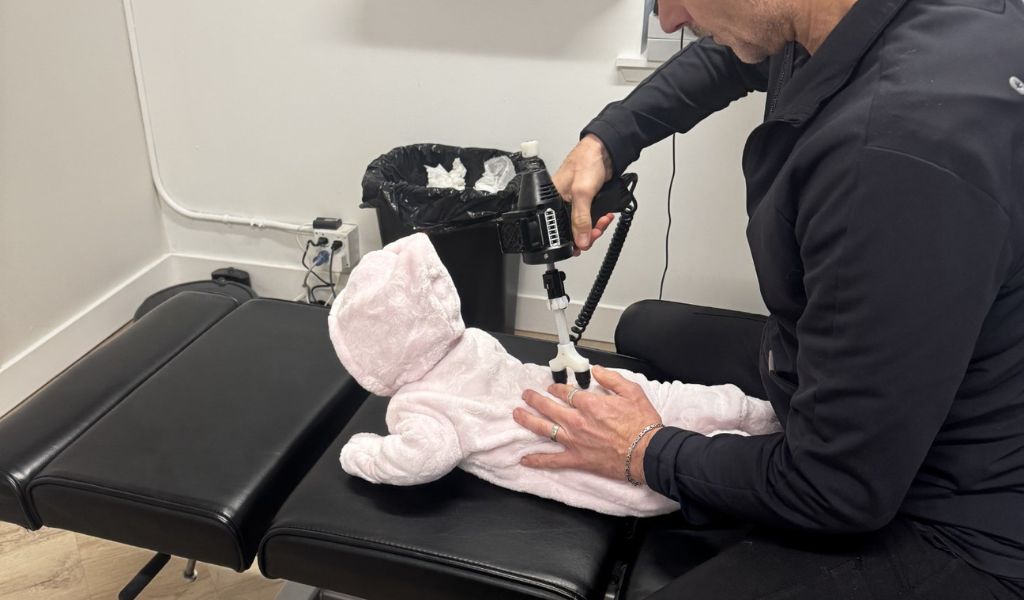
I want to be straightforward about this topic because I see a lot of exaggerated claims online, and parents deserve better than that when it comes to their kids. So let’s talk plainly: chiropractic care does not cure colic or ear infections, and I’m not going to tell you otherwise. What I can talk about is what a pediatric exam actually involves, what the current research does and doesn’t show, and when you should be calling your pediatrician instead of us.
What Colic and Ear Infections Actually Are
Colic is defined as extended, unexplained crying in an otherwise healthy infant, typically peaking around six weeks of age and improving by three to four months. Its exact cause isn’t fully understood, and it’s usually diagnosed by ruling other things out.
Ear infections (otitis media) happen when fluid builds up behind the eardrum, often following a cold, and become infected. They’re extremely common in young children partly because their eustachian tubes are shorter and more horizontal than an adult’s, which makes drainage less efficient.
Neither of these has an established chiropractic cure, and any provider who tells you otherwise is overselling what this care does.
What the Research Actually Shows
The honest state of the evidence, according to the National Center for Complementary and Integrative Health (NCCIH), is that research on spinal manipulation for infant colic and pediatric conditions like ear infections is limited, and existing studies have not established that chiropractic treatment reliably resolves these conditions. Some small studies have looked at crying time or parent-reported symptoms, but the overall evidence base is not strong enough to call this an established treatment for either issue.
That doesn’t mean gentle chiropractic evaluation has zero place in a family’s care plan, it means the honest claim is much narrower than “chiropractic fixes colic,” which is a claim I won’t make.
What I Actually Do at a Pediatric Visit
A pediatric exam at our office looks nothing like an adult adjustment. It involves:
- A detailed history, including birth history, feeding patterns, and sleep
- A gentle, age-appropriate physical exam checking spinal alignment and range of motion
- Extremely light-force techniques suited to an infant’s developing spine, nothing like the force used on an adult
- Clear communication with parents about what I’m finding and what I’m not finding
If a baby’s fussiness or an older child’s ear discomfort looks like it needs a pediatrician’s evaluation, medication, or hearing check, I say so directly and refer out.
When to See a Pediatrician, Not Us, First
Some symptoms need medical evaluation before anything else:
- Fever in an infant under three months old
- Pulling at the ear along with fever, or visible drainage from the ear
- Persistent vomiting, blood in stool, or signs of dehydration in a fussy infant
- Any concern about hearing, speech delay, or recurring infections needing tubes
Ear infections in particular often need a clinical diagnosis with an otoscope and, depending on severity and the child’s age, antibiotics. That’s outside what a chiropractic exam evaluates, and I’ll tell a parent plainly when that’s the path to take.
Why Parents Still Bring Kids In
Most of the families who come to us with young kids aren’t chasing a colic cure. They’re interested in a general wellness check on their child’s spine, especially after a difficult birth or a fall, similar to why they’d bring a kid in after a bike accident. That’s a reasonable, conservative reason to get evaluated, and it’s different from claiming we treat a specific childhood illness.
Frequently Asked Questions
Is chiropractic treatment safe for infants?
When performed by a provider trained in pediatric technique, using appropriately gentle, low-force methods matched to an infant’s anatomy, it’s generally considered low-risk. That said, “safe” and “proven to treat colic or ear infections” are two different claims, and I want to be clear I’m only making the first one.
Will you tell me if my child needs a pediatrician instead?
Yes, every time. If something in the exam or history points toward a medical issue rather than a musculoskeletal one, I refer out. That’s not a failure of the visit, it’s the point of an honest evaluation.
At what age can a child start seeing a chiropractor?
There’s no fixed minimum age, but technique and force are always matched to the child’s size and developmental stage. An infant exam looks completely different from what we’d do with a teenager.
Book an Honest Evaluation
If you want a gentle, honest evaluation of your child’s spine, or you have questions about whether chiropractic care fits your family’s situation, we’re glad to talk it through, no oversold promises. Call us at (425) 276-8044 or book an appointment. Our New Patient Special — $59 applies to new patients of any age. You can also learn more on our pediatric chiropractic and prenatal chiropractic pages, and read 5 signs you need to see a chiropractor for our general take on when evaluation makes sense. For older kids, our post on fitting a school backpack covers the next stage of pediatric spinal health.
References
- National Center for Complementary and Integrative Health (NCCIH): Chiropractic: In Depth
- National Institute of Child Health and Human Development / NIH: Colic
- Centers for Disease Control and Prevention (CDC): Ear Infection
Get Started Today
Start with a complimentary consultation to ask questions and confirm fit.