Every January I see the same pattern walk through the door. Shorter days, more time indoors, more time hunched over a phone or a laptop, and by the second week of the new year, a wave of patients complaining about the same thing: a dull ache at the base of the skull, tight shoulders, and a neck that just doesn’t turn the way it used to. We call it text neck, and around Renton it gets worse every winter, not better.
What’s Actually Happening in Your Neck
Your head weighs about 10-12 pounds when it’s balanced directly over your shoulders. Tilt it forward 45 to 60 degrees — which is roughly where your chin sits when you’re looking down at a phone — and the effective load on your cervical spine can multiply several times over. Hold that position for hours a day, every day, through a Puget Sound winter where you’re commuting on 405 in the dark both ways and then parked on the couch scrolling, and the muscles at the back of your neck and between your shoulder blades never really get to relax.
Over months, that constant load does more than tire out muscle. It changes the curve of your neck. A healthy cervical spine has a gentle forward curve (lordosis) that helps distribute load evenly. Chronic forward head posture flattens or even reverses that curve, which is part of why chiropractic biophysics exists as its own discipline — it’s specifically built around measuring and correcting spinal curves, not just chasing symptoms.
The Symptoms That Bring People In
- A persistent ache at the base of the skull that gets worse by end of day
- Tightness across the tops of the shoulders and between the shoulder blades
- Headaches that start at the neck and wrap toward the temples or behind the eyes
- Reduced rotation — you notice you can’t check your blind spot as far as you used to
- Numbness or tingling into the arm or hand, which is a sign the issue may be pressing on a nerve, not just muscle
If you’re dealing with headaches specifically, that’s often a downstream effect of the same postural pattern — we cover the mechanism in more detail on our headaches and migraines page.
What a Posture Reset Actually Looks Like Here
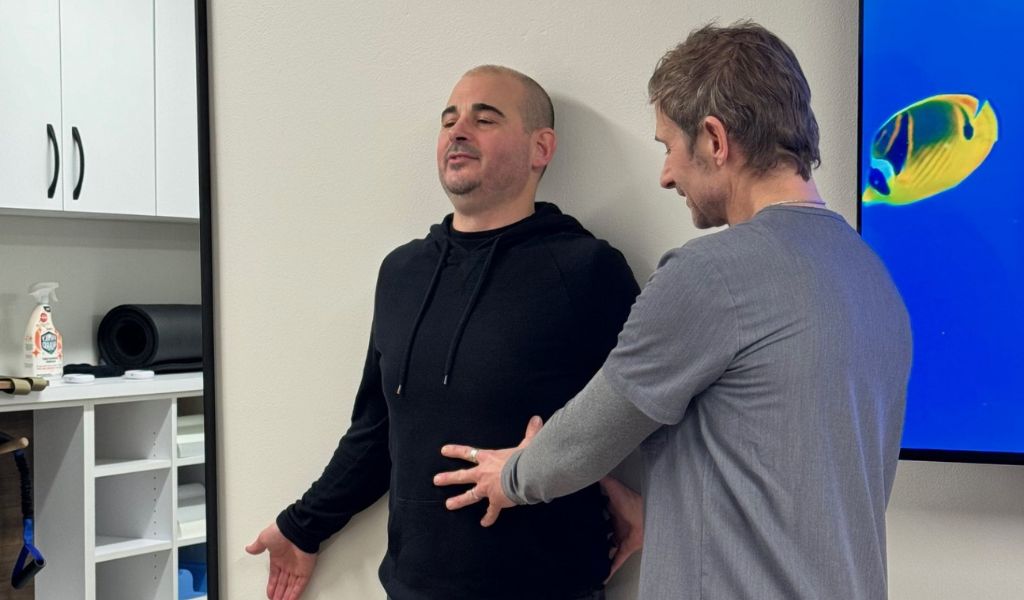
When someone comes in for this, the exam isn’t just “does it hurt when I push here.” I’m checking cervical range of motion in all planes, palpating the segments of the neck for restriction, and looking at how the head sits relative to the shoulders and hips — often with postural photos so we have a baseline to measure against later. If there’s any numbness, weakness, or radiating pain down an arm, I’ll also run orthopedic and neurological tests to rule out nerve involvement before we build a plan.
From there, care generally has two parts. The first is chiropractic adjustments to restore motion in segments that have locked up from months of holding one position. The second, and honestly the more important part long-term, is corrective exercise — specific movements that retrain the deep neck flexors and strengthen the muscles between the shoulder blades so your posture doesn’t just default back to forward-head the moment you sit down at a desk again.
A Few Things You Can Start Today
- Raise your screen. Phone or monitor, the goal is eye level, not chin-down.
- Set a 30-minute movement timer. Even 20 seconds of standing and rolling your shoulders back resets the load.
- Chin tucks, not neck stretches. Gently draw your chin straight back (like making a double chin) 10 times, a few times a day — it directly counters the forward-head pattern.
- Check your pillow. Side or back sleepers often do better with a pillow that keeps the neck neutral rather than flexed or extended.
When to See a Doctor Instead
Most text neck is mechanical and responds well to conservative care. But go to the ER or urgent care instead of scheduling a chiropractic visit if you have sudden severe neck pain after trauma, weakness in an arm or hand, loss of bladder or bowel control, or a headache that’s the “worst of your life” and came on suddenly. Those are red flags that need imaging and medical evaluation first.
Frequently Asked Questions
How long does it take to fix text neck?
It depends on how long the pattern’s been there and how consistent you are with home exercises, but most patients notice reduced tension within a few visits, with structural changes in curve and posture taking longer — typically measured in months, not weeks.
Is text neck the same as a pinched nerve?
Not usually. Text neck starts as a muscular and postural issue, but if it goes uncorrected long enough it can contribute to disc and joint changes that do irritate a nerve. If you have numbness or shooting pain into the arm, ask us to check for that specifically — we cover it more on our pinched nerve page.
Can I do this myself with stretching apps?
Stretching helps short-term tension but won’t correct an established postural pattern or restricted joint segments on its own. A proper exam tells you whether you’re dealing with tight muscle, a locked joint, or both.
Get Your Posture Reset Started
If your neck’s been paying the price for a winter of screens, don’t wait for it to turn into a headache problem. We’re currently running a New Patient Special for $59, which includes a full consultation and exam. Call us at (425) 276-8044 or use our online scheduler. You can also read more about what a first visit at Lakeside Spine and Wellness actually looks like or check 5 signs you need to see a chiropractor if you’re not sure your symptoms warrant a visit yet.
References
- National Institute of Neurological Disorders and Stroke, Back Pain Information
- Mayo Clinic, Neck pain - Symptoms and causes
Get Started Today
Start with a complimentary consultation to ask questions and confirm fit.