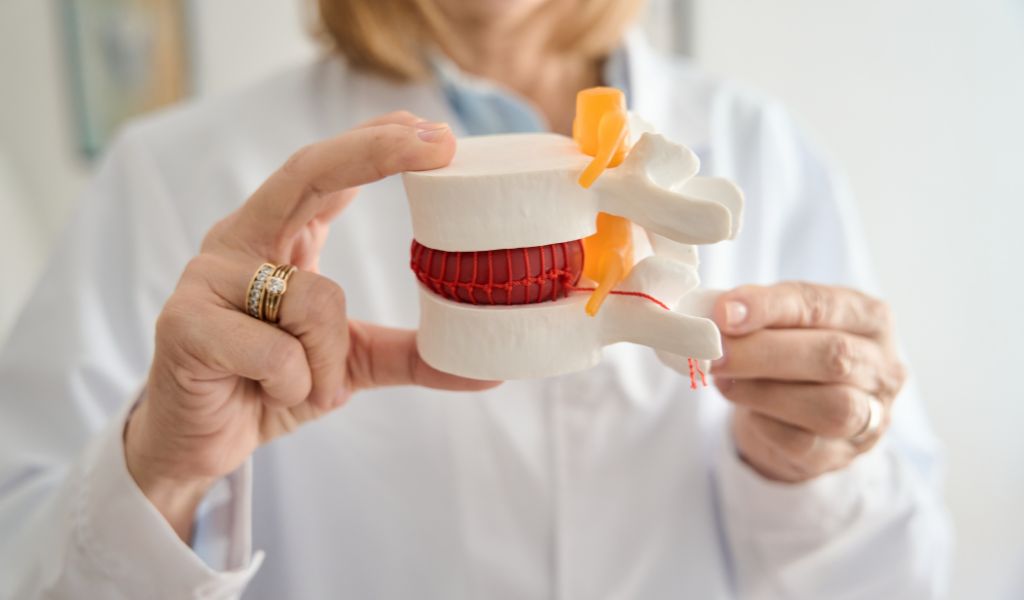
Patients bring me MRI reports almost every week that say some version of “disc bulge” or “disc herniation,” and most of them have no idea whether that’s bad news or just a normal part of getting older. It’s a fair question, and the two terms get used interchangeably online when they shouldn’t be.
The spinal disc, quickly
Between each vertebra sits a disc made of two parts: a tough outer ring called the annulus fibrosus, and a soft, gel-like center called the nucleus pulposus. Think of it like a jelly donut built to absorb shock and let your spine bend and rotate. Both bulging and herniated discs are problems with that structure, but they’re different problems.
Bulging disc
A bulging disc is when the outer ring stays intact but weakens and pushes outward, usually evenly around a wider section of the disc’s circumference. It’s often described as the disc “sagging” outward like a tire with low pressure. A lot of bulging discs show up on imaging and cause zero symptoms — they’re common findings in people over 30 with no back pain at all.
Herniated disc
A herniation means the outer ring has actually torn, and some of that gel-like nucleus has pushed through the crack. This is usually more localized rather than spread evenly around the disc, and it’s more likely to press directly on a nearby nerve root. That’s why herniated discs are more often associated with sharp, radiating pain down an arm or leg, not just local back or neck soreness.
Why the distinction changes how we treat it
I don’t treat a diagnosis on paper — I treat the person in front of me and what their body is actually doing. But the bulge-versus-herniation distinction still matters for a few reasons:
- Nerve involvement. A herniation pressing on a nerve root is more likely to cause numbness, tingling, or weakness that follows a specific pattern down the leg or arm, which points toward sciatica or a similar radiculopathy pattern — we go deeper on that overlap in sciatica vs. piriformis syndrome.
- Timeline expectations. Many disc herniations, especially in the low back, actually shrink over months as the body reabsorbs the extruded material. Bulging discs tend to be more of a chronic structural issue tied to posture and repetitive stress.
- What aggravates it. Herniations often flare with specific movements — forward bending, sitting for long periods, coughing or sneezing. Bulges tend to track more with overall load and posture through the day.
What we check in the exam
When someone comes in with disc-related pain, I’m not relying on imaging alone. A thorough exam includes:
- Orthopedic and neurological testing — straight leg raise, reflexes, sensation mapping, and strength testing in specific muscle groups to see if a nerve root is actually compromised, not just irritated.
- Movement assessment — which directions provoke or relieve symptoms tells me a lot about which structures are involved.
- Postural and structural screening — how your spine is aligned overall, since degenerative disc disease and repetitive postural stress often set the stage for both bulges and herniations over time.
Imaging is useful, but it’s one piece of information, not the whole picture. I’ve seen MRIs with significant findings on patients with almost no pain, and patients in real distress with a fairly unremarkable scan. The exam is what tells us what to actually treat.
How care typically progresses
For most disc bulges and many herniations without significant neurological deficit, conservative care is the appropriate first step — this is backed by NINDS guidance on herniated discs, which notes most people improve without surgery. At Lakeside Spine and Wellness, that usually means:
- Gentle, specific chiropractic adjustments to restore motion in the segments around the affected disc, avoiding aggressive movement directly at an acutely herniated level early on.
- Rehab exercise therapy to build stability around the spine so the disc isn’t taking the same repetitive load.
- Activity modification guidance — not “stop moving,” but which specific movements to avoid or modify while things settle.
We track progress with the same neurological and movement tests from the initial exam, not guesswork. If leg or arm weakness is progressing, or symptoms aren’t responding to a reasonable course of conservative care, that’s when we coordinate a referral for advanced imaging or a surgical consult.
Red flags — when this isn’t a “wait and see” situation
Go to urgent care or the ER, don’t wait for an appointment, if you experience:
- Loss of bladder or bowel control
- Numbness in the saddle area (inner thighs, groin)
- Rapidly progressing weakness in a leg, not just pain
- Fever combined with new severe back pain
These can indicate cauda equina syndrome or another emergency, and they’re rare but serious.
Frequently Asked Questions
Can a bulging disc turn into a herniated disc?
Yes, it’s possible over time if the outer ring continues to weaken under repeated stress, but it’s not inevitable. Plenty of bulging discs stay stable for years with the right activity habits and postural support.
Do I need an MRI before seeing a chiropractor?
Not usually. A clinical exam can identify red flags and guide initial care. If your symptoms don’t respond as expected or show neurological progression, we’ll recommend imaging at that point.
How long does it take to feel better?
It varies widely by severity and how long you’ve had symptoms, but many patients with disc-related low back or neck pain notice meaningful improvement within 4-6 weeks of consistent care. We reassess regularly rather than committing to a fixed timeline upfront.
Ready to Get an Accurate Answer?
If you’re dealing with back or neck pain and unsure whether it’s disc-related, don’t self-diagnose from a search engine. Come in for a real exam. New patients start with our $59 New Patient Special, which includes the consultation and exam needed to actually figure out what’s going on. Book your appointment online or call us at (425) 276-8044. You can also read about what a first visit looks like before you come in.
References
- NINDS: Herniated Disk
- Mayo Clinic: Herniated Disk
Get Started Today
Start with a complimentary consultation to ask questions and confirm fit.